Cannell, Stephen J. | 1997 | King Con | Avon Books, 1998 | 434p.
Stephen J. Cannell was best known for producing television shows such as Baa Baa Black Sheep, Riptide and The A-Team. His books are like his TV shows – fast, light, and lots of action. King Con is no exception.
Review
Breezy, novelized screenplay from TV screenwriter Cannell (Final Victim, 1996, etc.) almost makes crime cute. When charming card cheat and confidence man Beano X. Bates takes too much money out of the pocket of Armani-draped New Jersey mafia boss Joseph Rina, Rina nearly beats him to death with a golf club. Rather than testify against Rina in an upcoming trial, Bates leaves the hospital and disappears, leaving feisty, terminally beautiful state prosecutor Victoria Hart without much of a case. Then Carol Sesnick, a protected witness in the Rina trial, is found murdered, along with her two state-police bodyguards, at the bottom of an elevator shaft in a Trenton apartment building. Hiding out as a used-car salesman in Florida, Beano, who’s also on the FBI’s Ten Most Wanted list, feels bad seeing his face flashed on television. He wants to quit being a con man and live easy with his cute terrier Roger-the-Dodger, but, having descended from a family of grifters, Bates can’t quite ignore the calling of his blood. The murder of Sesnick, who’s descended from a family of gypsies that has intermarried with the Bates clan, gives him the excuse to use his nefarious skills to bring Rina to justice. He teams up with Hart and teaches her a thing or two about small-time scams and the joys of preying on the deservingly dishonest. The two fall in love and wind up sufficiently imperiled (having successfully duped Tommy “Two Times” Rina, Joe’s homicidal brother) to justify a slam-bang, ultraviolent finish just before the wedding bells ring. Cannell shows off his skill at Elmore Leonard style plot twists and slangy street dialogue, but his blend of cinematically detailed violence and pointless Hollywood fairy-tale scenes fails to convince. (Kirkus Review / April 15th 1997)
A very young rediscovery. King Con was a thoroughly enjoyable re-read. I will however not be rereading it anymore. As such I’ll donate my copy (postage unpaid) to anyone who requests it or to the Oxfam bookstore here in town.
Child, Lee | 1997 | The Killing Floor | Audible, 20xx | min.
This is a rediscovery of sorts. Although I have read or listened to – over the past twenty years – all the Jack Reacher books, I only now got around to listen to his debut novel and also the first book to feature the character Jack Reacher.
Child’s story veers into the excessive and silly on occasion, but with controlled Reacher as the narrator it gives the book and story a solid, almost reasonable-sounding foundation. It is ultimately an over the top fantasy-thriller, both regarding the crime and the criminal’s reach — right down to too-neat Margrave (“the most immaculate town I had ever seen”) a town so flush with cash that no one seems to do any real work — and the violence. Also the distances traveled — Reacher drives and flies far and wide. (Some of the less likely elements — such as how Finlay wound up in Margrave — at least add a nice humorous touch.) But it’s just plausible enough — and nicely detailed and observed — to make for an engaging enough read, bouncing rapidly and constantly from one tense situation or confrontation to the next.
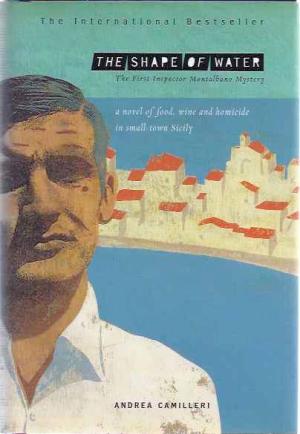
Camilleri, Andrea (2002). The Shape of Water. Originally published in Italian as La forma dell’ acqua (1994). My copy: Viking Penguin, New York, 2002.
REDISCOVERY NOTE
Andrea Camilleri died on July 17th, 2019. A sad moment to rediscover this superb author who only started writing his Montalbano novels in 1995, aged 70.
Andrea Camilleri’s appeal did not lay in the detective aspects of his books, though those are certainly satisfying, but in the many characters that populate them. Each and everyone seems to have walked in from real life, only to return to their daily lives again when they leave. The detective story is but the form to create a warm, colorful, ‘chiaroscuro’ universe full of contrasts, as one only finds in the Italian south. A mere pretext to describe a kaleidoscope of characters, movements, everyday life, history, humanity and ruthlessness in which Camilleri’s particular style of interwoven neologisms gives a unique touch to the art of describing the deep South in a way you always want to rediscover.
‘Salvù’, commissioner Salvo Montalbano, is first man and then commissioner, character of a rectitude and human sensibility difficult to preserve in a land full of contrasts and continuous compromises.
The 30 books are absolutely devoid of references to real life, but since the latter tends to continually overcome the imagination, the author ‘washes his hands’ (‘lava le mani’) of the coincidences that ‘the games of chance’ (‘il giochi del caso’) cannot charge him for responsibility. Fantastic!
JACKET NOTES
Andrea Camilleri’s Inspector Montalbano has become a phenomenal success whose adventures have been translated from Italian in eight languages, from Dutch to Japanese. The Shape of Water is the first book in a sly, witty, engaging series, with a sardonic take on Sicilian life.
The goats of Vigata once grazed on the trash-strewn,
sirocco-swept site still known as the Pasture. Now local enterprise of a
different sort flourishes: drug dealers and prostitutes of every
flavor. But their discreet trade is upset when two employees of the
Splendor Refuse Collection Company discover the body of engineer Silvio
Luparello, one of the local movers and shakers–apparently deceased in
flagrante at the Pasture. The coroner’s verdict is death from natural
causes–refreshingly unusual for Sicily. But Inspector Salvo Montalbano,
as honest as he is streetwise and as scathing to fools and villains as
he is compassionate to their victims, is not ready to close the
case–even though he’s being pressured by Vigata’s police chief, judge,
and bishop.
The Shape of Water is the first in Camilleri’s series of contemporary mystery novels featuring Inspector Salvo Montalbano and set in Vigáta, a fictional seacoast town in southern Sicily. One can’t help but love this Montalbano character. He’s an unpretentious and honest Italian policeman who doesn’t care who he offends when he is intent on solving the crime of the moment. In this case, there doesn’t seem to be a crime at all when an influential local contractor is found dead in a very compromising situation. The deceased Silvio Luparello appears to have had a last fling with a prostitute and suffered a massive and fatal heart attack in the process. Montalbano becomes suspicious when a powerful politician, a judge, and a bishop all apply pressure to quickly close the investigation. Our hero manages to get a 48-hour extension during which he sorts it all out.
Camilleri is a master at describing this part of Sicily and the vast array of interesting characters local to the area. Montalbano’s many colleagues in the Questura are a delightful bunch of guys. Livia, his ladyfriend, is in Genoa and much of their relationship is over the phone. He is often tempted by other beautiful women but always remains faithful. Any Italian story, worth it’s salt, has to talk about food. Camilleri does not disappoint — Montalbano not only has a housekeeper, Adelina, who always leaves his refrigerator stocked with mouth-watering local seafood delicacies; but his commissario’s wife regularly invites him to dinner to sample her creative recipes.
Stephen Sartarelli does an admirable job in translating Camilleri’s novel from the Italian. While reading THE SHAPE OF WATER, you always get the sense that this is an Italian mystery about Italian characters and written by a superb Italian author. – by Carlo Vennarucci, italian-mysteries.com, November 2003
 Rediscovering my Library